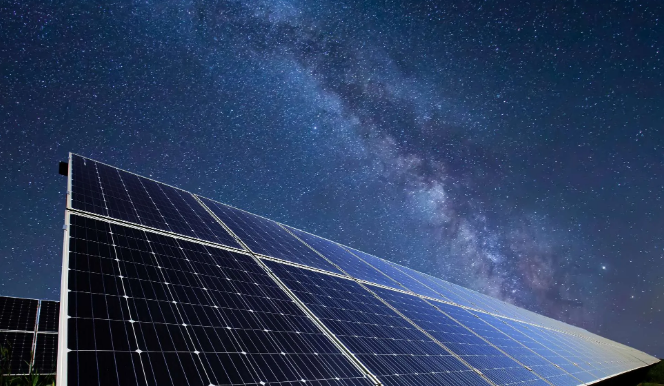
There is a common question that our clients frequently ask when discussing solar panels: do they also function at night. It is true that solar panels require sunlight to generate electricity. However, they can create a small amount of power even when it is dark. While this may seem surprising, solar panels collect enough energy even during the night.
At night, there is very little light: the moon, the stars, the streetlights in towns. Some highly efficient solar panels can also convert this faint light into electricity.
It is possible to use a special type of solar cells that capture infrared rays given off by the Earth at night. These cells turn infrared radiation into usable electric power. The efficiency is low, but it leads to additional production.
Do photovoltaic panels also work at night?
Hybrid panels, which have solar cells and built-in batteries, enable the storage of extra energy created during the day. This stored energy can be utilized to power your home at night.
Certain solar panels are made to make the most of moonlight. They have solar cells that perform well in the light reflected from the moon and generate energy particularly at night.
There are solar systems with solar trackers that automatically adjust the panels to follow the moon’s position at night. This way, the electricity gained from moonlight is increased.
At night, electricity can also be generated from solar panels with solar concentrators. At night, they focus the weak light onto the solar cells.
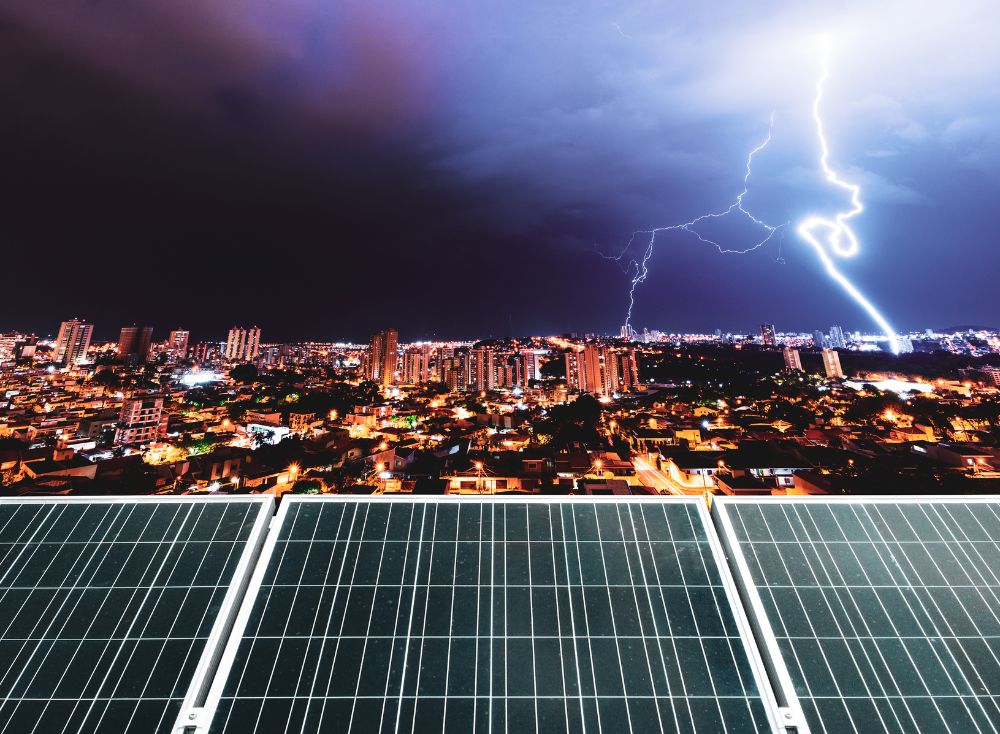
Imagine having solar panels at home to which batteries are also connected. During the day the photovoltaic panels charge the batteries with energy from the sun. In the evening, when it gets dark, the panels no longer produce electricity as during the day. But don’t be left in the dark! The system automatically releases the energy stored in the batteries and continues to power your home.
So in fact you have free electricity non-stop: during the day directly from the panels, at night from the reserve charged during the day. The batteries are charged every day where the sun rises.
This way you will benefit 24 hours a day from your investment in solar panels. Save green energy for the nights and use it when the panels are no longer so efficient. So you can enjoy clean electricity without
Conclusion
A frequent and entirely logical question that arises when discussing the operation of photovoltaic technology is whether solar panels can continue to function during the night. As the text observes, while it is fundamentally true that solar panels require sunlight to produce their standard output of electricity, the notion that they become completely inactive in the dark is a common misconception. Although it seems highly counterintuitive to most consumers, modern photovoltaic modules are sensitive enough to interact with ambient environmental factors, allowing them to generate a microscopic amount of electricity even during nighttime hours. This nuanced capability highlights the sophisticated nature of solar engineering and its continuous adaptation to ambient conditions.
To understand this phenomenon, it is necessary to examine the physical mechanics of how solar panels interact with alternative light sources after sunset. Even in the dead of night, the Earth’s atmosphere is not entirely devoid of radiation; photons from moonlight, cosmic rays, and artificial urban light pollution still strike the panels’ surfaces. Because the specialized semiconductor materials within high-quality photovoltaic cells are engineered to react to light across a broad spectrum, they can catch these faint, stray photons and convert them into a very small, albeit negligible, flow of direct current (DC). This subtle process demonstrates that the photovoltaic effect does not completely shut off, but rather scales down drastically in accordance with the available light energy.
However, from a practical and commercial business perspective, relying on nighttime generation is not how a solar system maintains a continuous power supply for a home or enterprise. Instead, the true solution to nighttime energy needs lies in the strategic deployment of modern energy storage and grid integration technologies. During peak daylight hours, a properly optimized solar array generates a massive surplus of electricity that far exceeds immediate consumption demands. By diverting this excess clean energy into dedicated battery storage systems or feeding it back into the utility grid through net metering programs, consumers can accumulate and secure enough power during the day to seamlessly cover all of their electricity needs throughout the night.
Ultimately, addressing the question of nighttime solar operation allows businesses to educate consumers on the complete, holistic ecosystem of renewable energy. While the panels themselves maintain a fascinating, low-level atomic responsiveness to ambient night light, the ultimate reliability of a solar installation depends on smart energy management. Combining high-efficiency panels with robust storage solutions ensures that a property remains fully powered twenty-four hours a day. By dispelling myths and explaining the synergy between generation and storage, solar providers can instill greater confidence in prospective buyers, proving that transitioning to solar infrastructure guarantees a stable, uninterrupted, and entirely sustainable energy future.
latest posts published
About new generation thermodynamic solar systems
Solar panels and minimalist design: how to integrate them into modern architecture
The impact of solar energy on the energy market landscape
How to choose the right electric scooter for my lifestyle
Innovative solutions to monetize the energy of domestic solar panels
What is the difference between prosumer and producer of electricity
Solar panels for your business, profitable or not?
Solar panels for charging electric vehicles
Renewable solar energy: clean and healthy future